Short answer: To start a cleaning business, pick the type of cleaning you’ll do, choose and register a business name, get an EIN and any licenses your city, county and state require, buy general liability insurance, set your prices, put together your estimate, invoice and checklist paperwork, and then go find your first few clients. Most solo cleaners can do all of that in a few weeks for far less than most other businesses cost to start. The rules vary by state and city, so check your local requirements as you go.
This guide walks through each step in order. It is written for owner-operators: you, maybe a partner, maybe a helper or two. No franchise, no office, no fancy software.
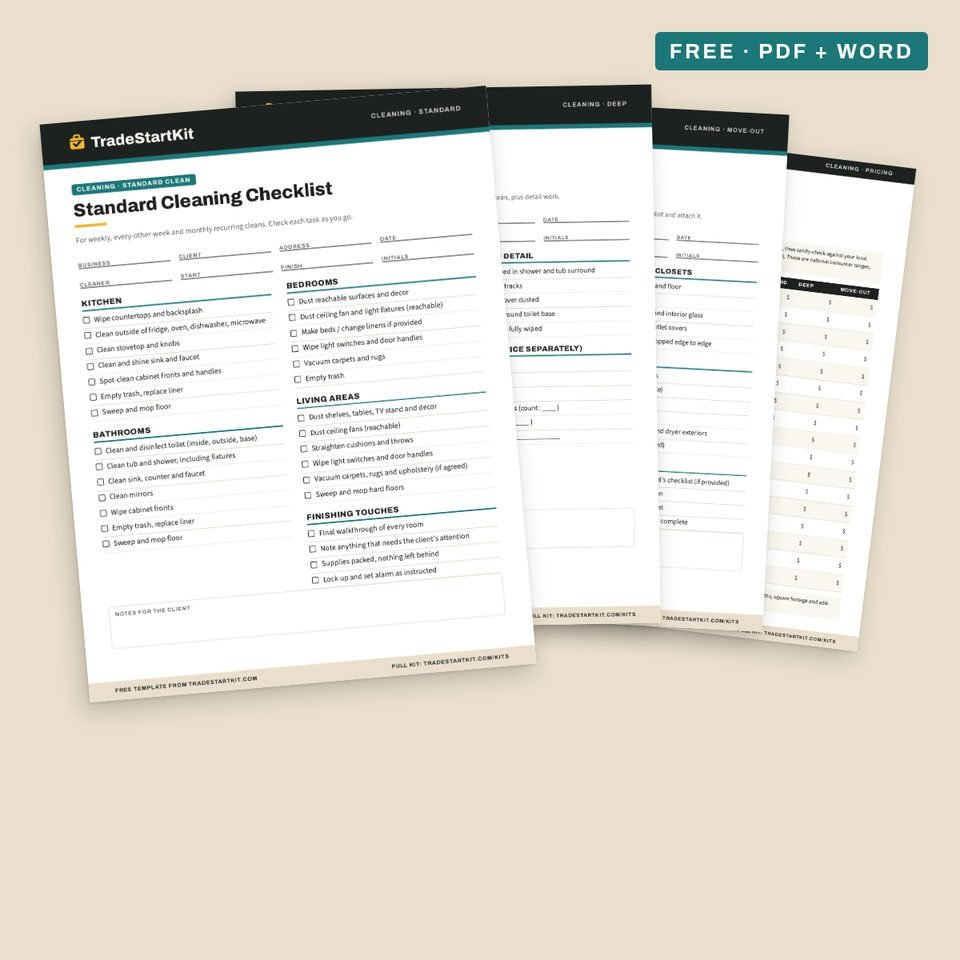
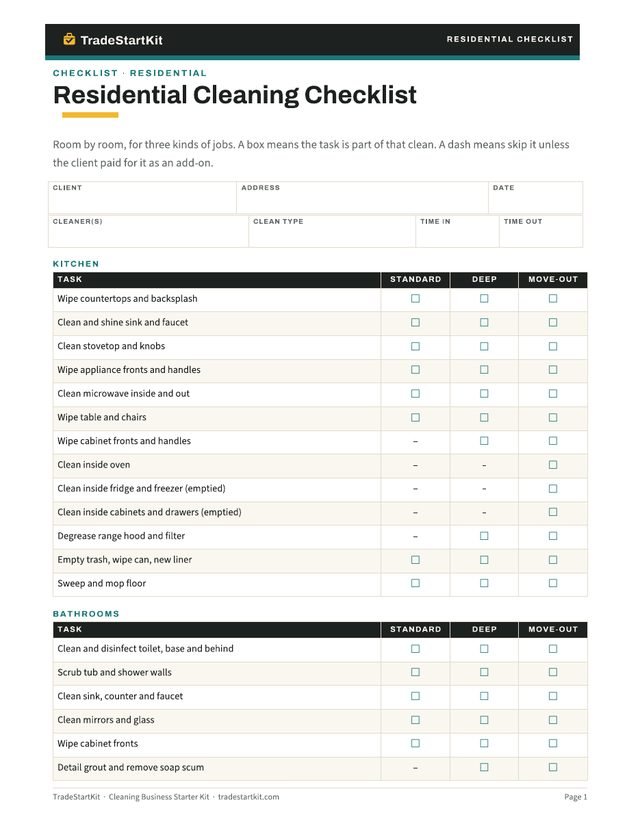
Free download: Grab our free cleaning checklist pack (standard, deep and move-out checklists plus a price-per-room cheat sheet). It’s the same format pros hand to clients.

Step 1: Decide what kind of cleaning you’ll do
“Cleaning business” covers a lot of ground. Pick one lane to start. You can add more later.

- Residential (house cleaning): Recurring weekly, every-other-week or monthly cleans for homeowners and renters. The most common starting point because you can begin with one client and basic supplies.
- Deep cleaning and move-in/move-out: One-time jobs with a bigger scope (inside cabinets, appliances, baseboards). Higher ticket, less predictable.
- Short-term rental turnovers: Cleaning between guests for Airbnb and VRBO hosts. Tight time windows and a laundry component.
- Commercial and office cleaning: Evenings or weekends, usually under a written contract. Clients may ask for proof of insurance and bonding before you start.
- Specialty: Carpet, windows, post-construction. These usually need more equipment and know-how.
Tip: Start with the work you already know how to do well and can price confidently. Many owners start residential, then add deep cleans and move-outs as add-on services.
Step 2: Check your local market
Before you print a single business card, spend an evening looking at who already cleans in your area.
- Search Google Maps for “house cleaning near me” from your zip code. Note how many companies show up and how many reviews they have.
- Look at three or four competitor websites. Write down the services they list, whether they post prices, and what areas they cover.
- Check local Facebook groups and Nextdoor for people asking for cleaners. What do they ask about? Price, trust, availability?
- Decide your service area. A tight radius (for example, 15 to 20 minutes of driving) keeps travel time from eating your day.
You’re looking for a gap you can fill: an underserved suburb, a service nobody advertises (like move-out cleans for apartment complexes), or simply better communication and more professional paperwork than the competition.
Get the paperwork done tonight. The TradeStartKit Cleaning Business Starter Kit has editable estimate, quote and invoice templates, a pricing calculator, cleaning checklists, client intake forms and a business plan template. Editable in Word, Excel and Google Docs or Sheets. See what’s inside →
Step 3: Write a simple business plan
You don’t need a 40-page document unless you’re asking a bank for a loan. The U.S. Small Business Administration describes two styles: a traditional plan with detailed financials, and a lean one-page plan that covers your customers, value, costs and revenue in brief (SBA: Write your business plan). For a solo cleaning business, a lean plan is usually enough.
Answer these on one page:
- Who: Who are your ideal clients? (Busy families in a specific area? Property managers? Small offices?)
- What: Which services, and which will you not do?
- Where: Your service area.
- How much: Your pricing method and minimum job charge (see Step 6).
- Costs: Startup costs and monthly costs (supplies, insurance, gas, phone, software).
- How you’ll get clients: Your first three marketing actions.
Our free cleaning business plan template walks you through each section with fill-in prompts.
Step 4: Choose a name and a business structure
Pick a name you can actually use
A good cleaning business name is easy to say, easy to spell and tells people what you do. Before you commit:
- Search your state’s business entity database (the SBA keeps a state registration lookup).
- Search Google and Facebook for the name in your area.
- Check whether the domain name and social handles are free.
- If you plan to grow beyond your area, do a trademark search at the USPTO.
Pick a structure
The most common choices for a new cleaning business are a sole proprietorship and a limited liability company (LLC).
- A sole proprietorship is the simplest. If you do business under your own legal name, you may not need to register anywhere, according to the SBA. If you use a different name, you’ll usually need to file a “doing business as” (DBA) name.
- An LLC is registered with your state and can separate your business liabilities from your personal assets. Filing fees and annual fees vary by state.
The SBA explains the trade-offs between structures in its guide to choosing a business structure. If you’re unsure, a one-hour session with a local accountant or your nearest Small Business Development Center (often free) is money well spent.
Step 5: Register, get an EIN and sort out licenses
Register your business
If you formed an LLC or filed a DBA, register with your state (usually the Secretary of State) and/or your county, as your state requires (SBA: Register your business).
Get an EIN (it’s free)
An Employer Identification Number is a federal tax ID for your business. You’ll need one to hire employees or run an LLC with more than one member, and most banks ask for one to open a business account. You can apply online directly with the IRS for free and get the number immediately (IRS: Get an EIN). The IRS warns that you never have to pay a fee for an EIN, so skip any site that charges for one. If you’re forming an LLC, form it with your state first.
Licenses and permits
There is no single national “cleaning license.” What you need depends on your state, county and city. Common requirements include:
- A general business license from your city or county.
- A state sales tax permit if your state taxes cleaning services. For example, the Texas Comptroller says maid, janitorial and custodial services are taxable in Texas and providers should collect sales tax, with a narrow exception for a self-employed person working directly for a household (Texas Comptroller: Cleaning and Janitorial Services). Many other states don’t tax residential cleaning. Check with your state’s revenue department.
- Home occupation permits in some cities if you run the business from home.
Rules vary by state and city. Call your city or county clerk’s office and ask: “What do I need to run a residential cleaning business from my home?” It’s the fastest way to get a straight answer.
Step 6: Set your prices
Pricing is where most new cleaners get stuck. There are four common ways to charge:
| Method | How it works | Best for |
|---|---|---|
| Hourly | Rate per cleaner per hour | Jobs where you can’t predict the time yet |
| Flat rate | One price per visit based on home size | Recurring clients, once you’ve timed a home |
| Per room | Price per bedroom and bathroom | Simple quoting over the phone |
| Per square foot | Price times square footage | Larger homes, commercial spaces |
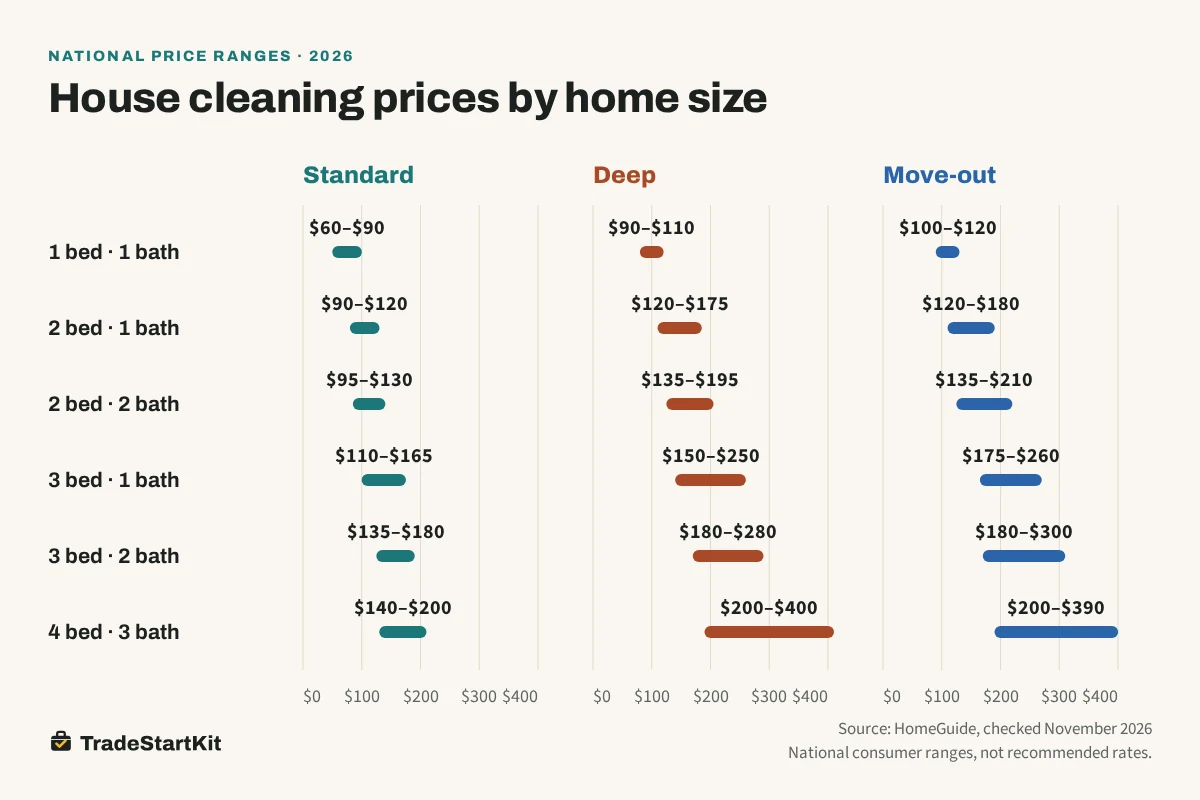
For context, HomeGuide’s 2026 cost guide lists house cleaning at $25 to $75 per hour per cleaner and $120 to $280 for a typical visit, with a standard clean of a 3-bedroom, 2-bathroom home at $135 to $180 (HomeGuide). Angi puts the average visit at about $175 (Angi). These are national consumer price guides, not a promise of what you’ll charge or earn. Your local market, your costs and the condition of each home set your real number.
Whatever method you pick, start from your costs: your own hourly pay target, supplies, gas and travel time, insurance, phone and software, plus a margin. We walk through the math in How Much to Charge for House Cleaning.
Price a home in minutes. The kit’s pricing calculator does the math: enter your rates, the beds, baths and square footage, and add-ons, and it gives you a quote you can paste straight into your estimate. Get the Cleaning Kit →
Step 7: Get insured (and consider a bond)
Insurance is the step new cleaners are most tempted to skip. Don’t. You’ll be in other people’s homes, around their floors, furniture and valuables.
- General liability insurance covers things like a client slipping on a wet floor or you accidentally damaging property. Insureon reports cleaning businesses that buy through its platform pay a median of about $59 a month for general liability, with house cleaners at about $51 a month (Insureon). Your premium depends on your state, services, revenue and claims history.
- Janitorial (surety) bonds reimburse a client if an employee steals from them. Insureon notes that bonds aren’t legally required, but many clients only hire businesses that are “bonded and insured.” Their reported median is about $9 a month (Insureon: Janitorial bonds).
- Workers’ compensation is generally required once you have employees in most states, but the rules vary by state. Check your state’s workers’ compensation agency (U.S. Department of Labor directory).
- Commercial auto may be needed if you drive between jobs with equipment. Ask your agent whether your personal policy covers business use.
Get at least two or three quotes. Insurance requirements and prices vary by state.
Step 8: Buy supplies and equipment
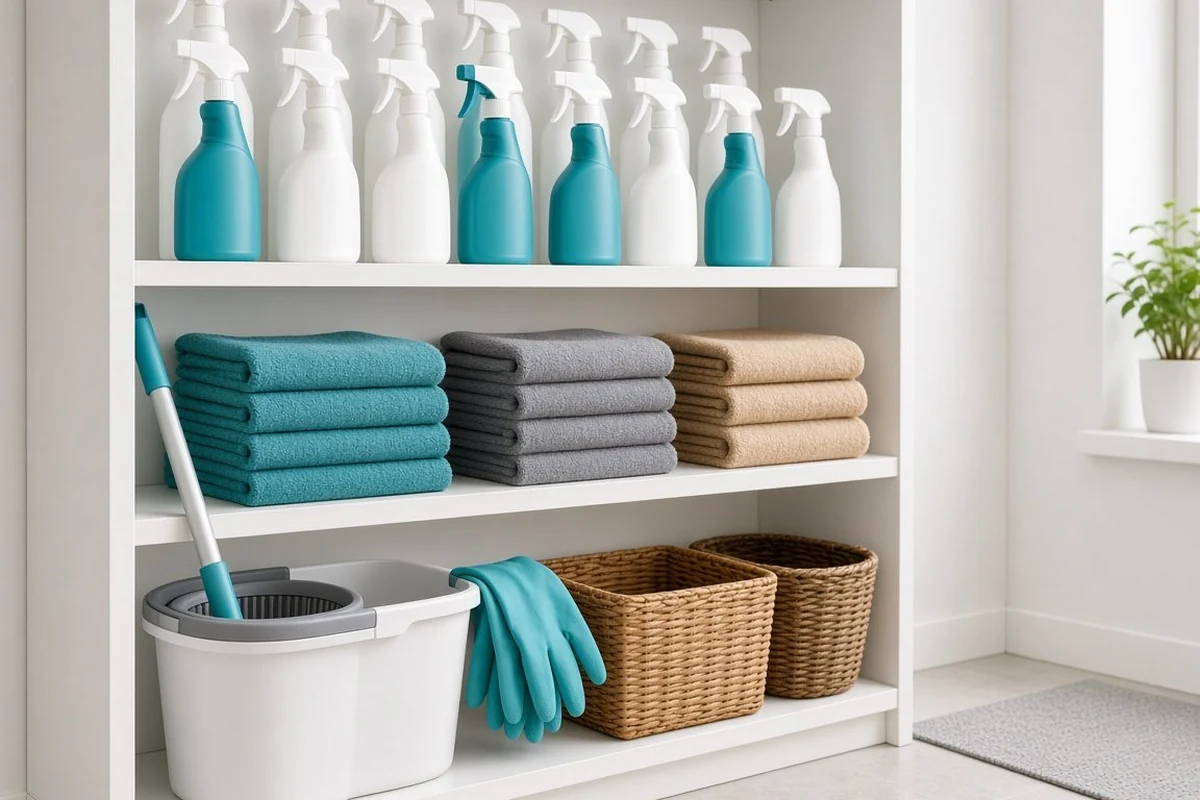
Start lean. Buy what you need for the services you offer, not everything on a “pro cleaner” shopping list. A typical residential starter set includes:
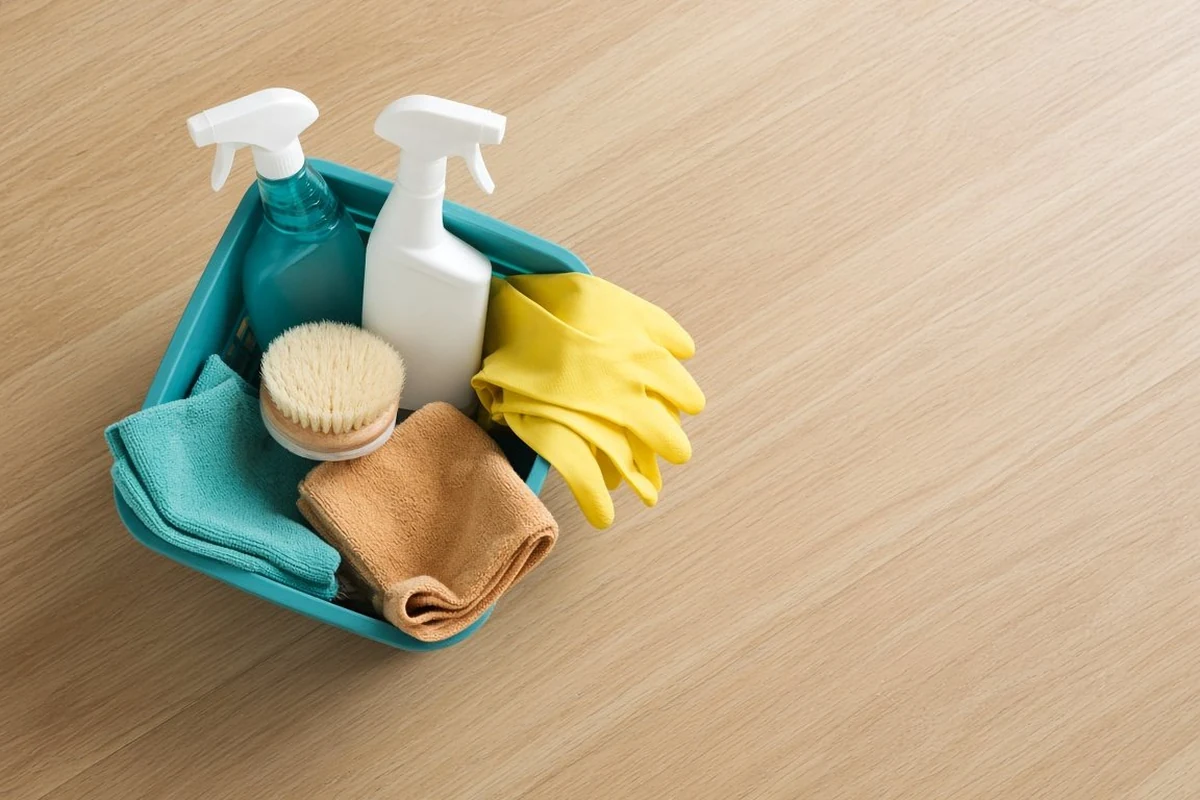
- A good vacuum (with a HEPA filter if you can)
- Microfiber cloths (color-code them: one color for bathrooms, another for kitchens)
- Mop and bucket, or a flat mop system
- All-purpose cleaner, glass cleaner, bathroom cleaner, degreaser and a disinfectant
- Scrub brushes, a toilet brush, grout brush and scraper
- Extension duster
- Caddy or tote to carry it all
- Gloves and basic protective gear
Read the label on every product and follow it, especially dwell times for disinfectants and warnings about mixing chemicals. Never mix bleach with ammonia or acids.
Step 9: Set up your paperwork and systems
This is where you start looking like a pro. Before your first job, have these ready:
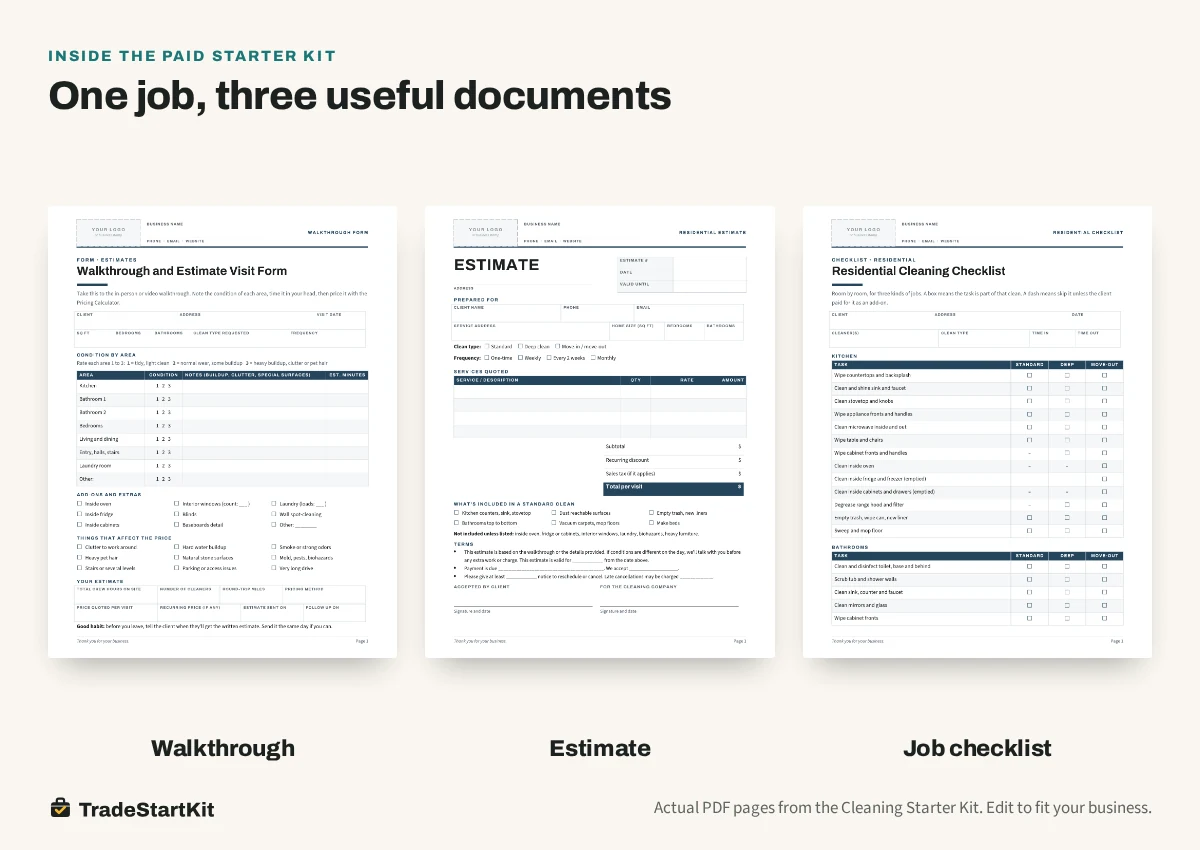
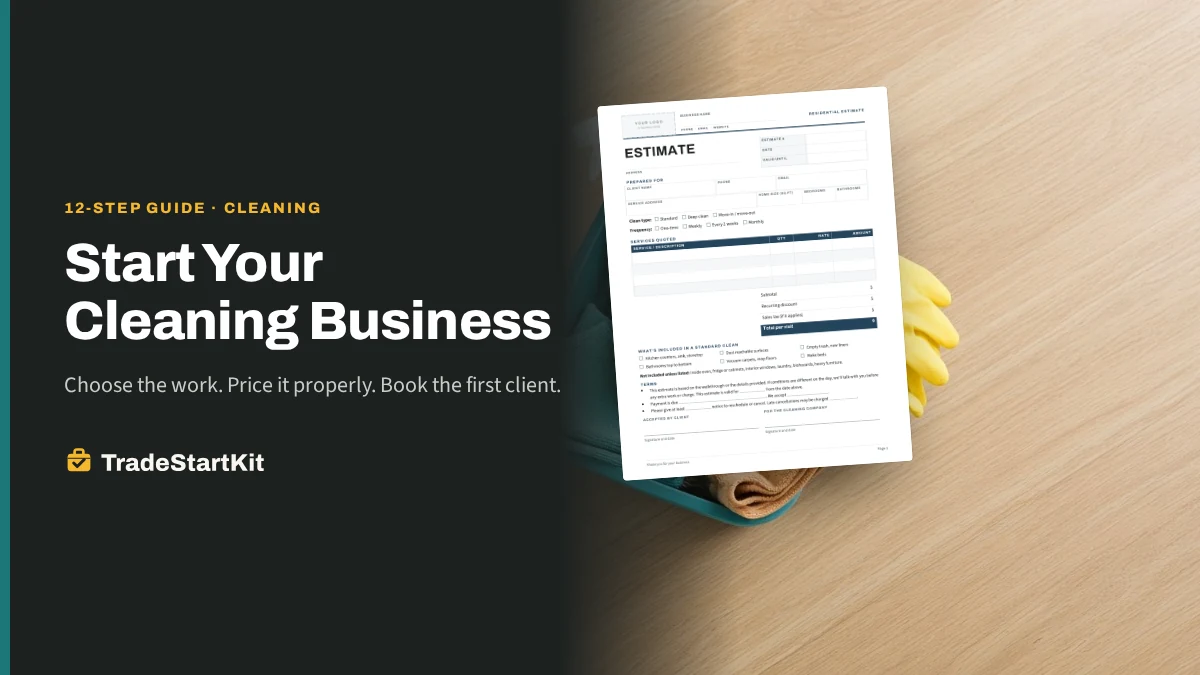
- Estimate / quote template: A clean, branded document that lists the scope, price, add-ons and terms. Your first client sees your estimate before they ever see your work.
- Service agreement: Spells out what’s included, cancellation and lockout fees, payment terms and what happens if something gets damaged.
- Cleaning checklists: One per service type so nothing gets missed and clients know what they’re paying for. Start with our free cleaning checklist template.
- Invoice template: With your business details, an invoice number, the date, line items and payment terms. See our free cleaning invoice template.
- Client intake form: Captures entry instructions, pets, alarm codes, priorities and allergies.
- Bookkeeping: A separate business bank account plus a spreadsheet or app to track income and expenses. The IRS generally asks you to keep records that support your income and deductions, typically for at least three years after you file (IRS: How long should I keep records?).
You can build each of these yourself in Word or Google Docs. Or you can skip the blank page: the Cleaning Business Starter Kit includes all of them, already designed, with your logo and details dropped in.
Step 10: Plan your taxes
When you work for yourself, nobody withholds tax from your pay. A few basics:
- If your net earnings from self-employment are $400 or more, you generally must pay self-employment tax (Social Security and Medicare), currently 15.3% on most net earnings (IRS: Self-employment tax).
- You may need to make quarterly estimated tax payments if you expect to owe $1,000 or more for the year (IRS: Estimated taxes).
- If your state taxes cleaning services, you’ll collect and remit sales tax (see Step 5).
Set aside a portion of every payment in a separate account for taxes. A local tax professional can tell you how much based on your situation.
Step 11: Find your first clients
You don’t need a big budget to land your first few clients. Start where people already know you, then widen the circle.
- Friends, family and neighbors: Tell people what you’re doing and ask for referrals. Offer a referral thank-you (like a discount off their next clean).
- Google Business Profile: Free, and it’s how most local customers find a cleaner. Add your service area, hours, services and real photos of you and your setup.
- Nextdoor and local Facebook groups: Answer “Can anyone recommend a cleaner?” posts promptly and politely. Follow each group’s rules on self-promotion.
- Flyers and door hangers: Target neighborhoods you’d like to work in (check local rules, and never put flyers inside mailboxes: federal law bars placing unstamped items in them, per 18 U.S.C. § 1725).
- Property managers and realtors: Move-out and move-in cleans are a natural fit. A professional one-page service sheet goes a long way here.
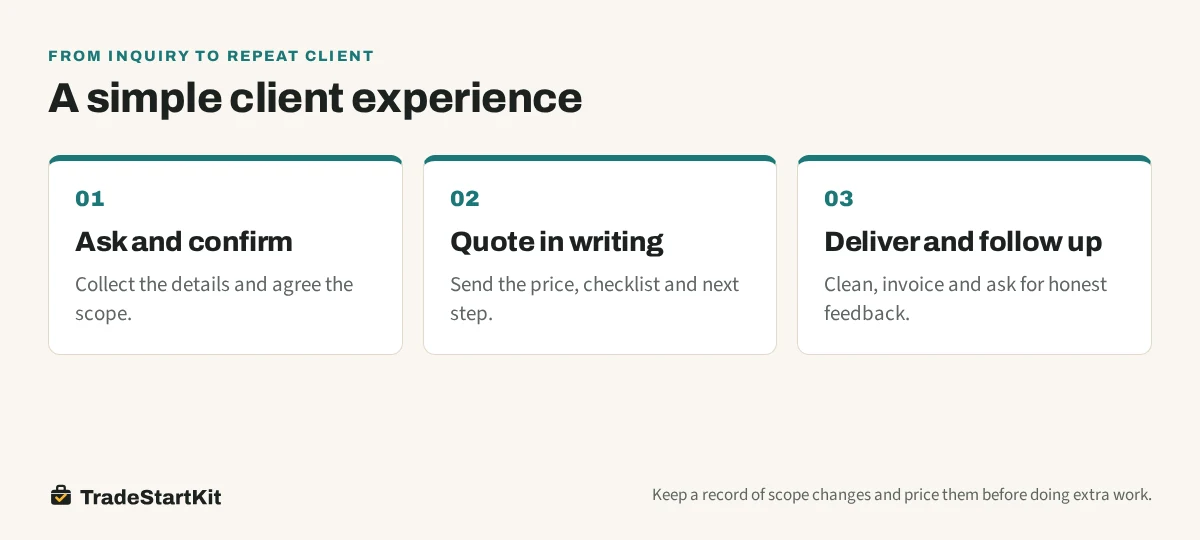
When someone asks for a quote, respond fast and send a real estimate, not a text message with a number. Then follow up two days later if you haven’t heard back.
Step 12: Deliver, ask for reviews, then grow
Your first 10 clients are your marketing department. Show up on time, follow your checklist, leave the home better than you found it, and send a clean invoice the same day.
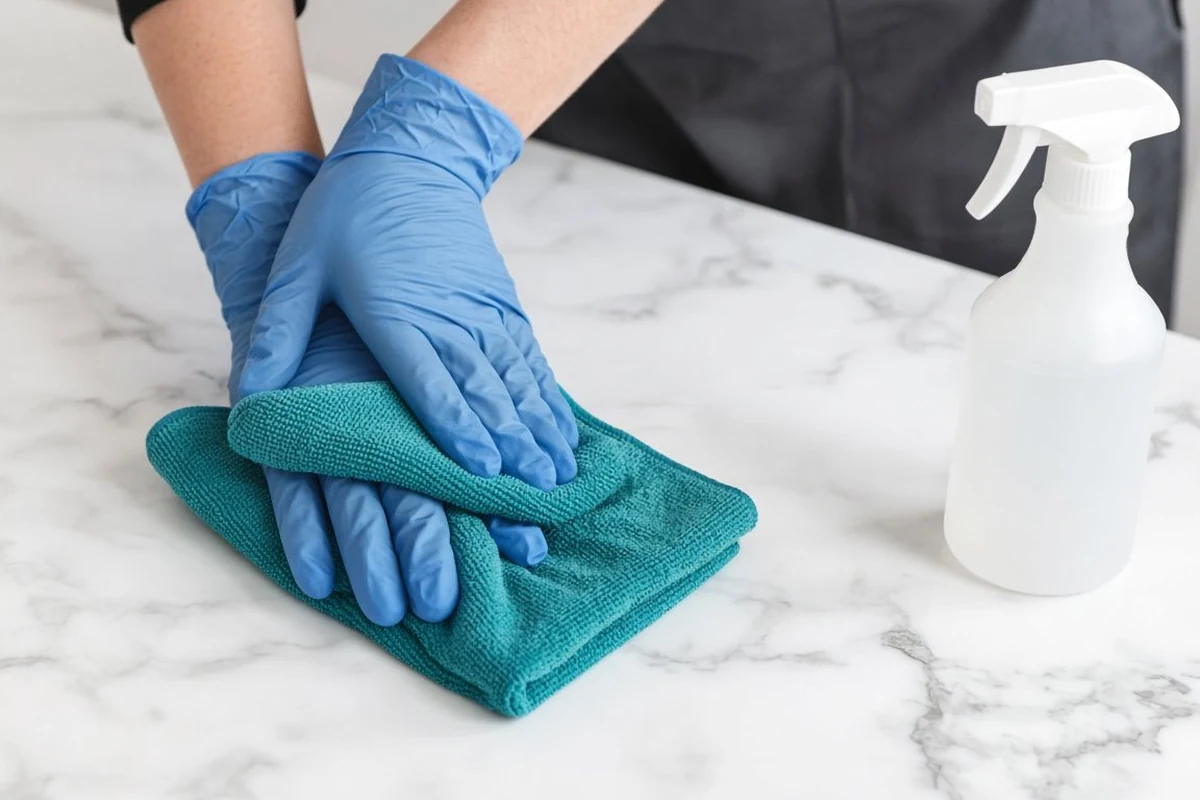
After each job:
- Thank the client and ask how it went.
- Ask happy clients for a Google review (send them the direct link).
- Offer a recurring schedule if they booked a one-time clean.
- Write down how long the job took. This data makes your next quote more accurate.
Once your schedule fills up, you’ll face the “hire or not” question. If you bring on help, learn the difference between an employee and an independent contractor first. The IRS has a plain guide on how to tell the difference, and misclassifying workers can be costly. You’ll also need workers’ compensation in most states once you have employees.
Look professional from day one. The Cleaning Business Starter Kit gives you the estimates, invoices, pricing calculator, checklists, SOPs and business plan a seasoned pro already has, ready to fill in tonight. $37, instant download. Get the Cleaning Kit →
Your cleaning business startup checklist
Use this as a quick recap. (Want it as a printable? It’s inside the free checklist pack.)
- ☐ Chose a service lane (residential, deep/move-out, rental turnovers, commercial)
- ☐ Researched local competitors and set a service area
- ☐ Wrote a one-page business plan
- ☐ Picked and checked a business name
- ☐ Chose a structure (sole proprietor, LLC) and registered as required
- ☐ Got a free EIN from the IRS
- ☐ Checked city, county and state license and sales tax rules
- ☐ Bought general liability insurance (and a bond, if your clients expect one)
- ☐ Set prices and a minimum job charge
- ☐ Bought starter supplies
- ☐ Set up estimate, agreement, checklist, invoice and intake forms
- ☐ Opened a business bank account and started tracking expenses
- ☐ Set up a Google Business Profile
- ☐ Told 20 people you’re open for business

Frequently asked questions
How much does it cost to start a cleaning business?
It depends on the services you offer and what you already own. A solo residential cleaner mainly needs supplies, a vacuum, insurance and any local registration fees. Insureon reports a median of about $59 a month for general liability insurance for cleaning businesses that buy through it. LLC filing fees, license fees and sales tax permits vary by state and city, so check your local costs before you budget.
Do I need a license to start a cleaning business?
There’s no national cleaning license, but most cities or counties require a general business license, and some states require a sales tax permit because they tax cleaning services (Texas is one example). Rules vary by state and city, so call your city or county clerk and your state revenue department to confirm.
Do I need an LLC to start a cleaning business?
No. You can start as a sole proprietor. Many owners form an LLC to separate business liabilities from personal assets. The SBA’s guide to business structures explains the trade-offs, and a local accountant or Small Business Development Center can help you decide.
Should my cleaning business be bonded and insured?
General liability insurance is strongly recommended for anyone cleaning in other people’s homes or offices. Bonds aren’t legally required in most cases, but many clients, especially commercial clients and property managers, only hire businesses that are bonded and insured.
How do I price my first cleaning jobs?
Start from your costs (your pay, supplies, travel, insurance and overhead), then check your price against local competitors. National guides like HomeGuide list $25 to $75 per hour per cleaner, but your area may differ. Time every job so you can switch to flat-rate pricing once you know how long homes take.
How do I get my first cleaning clients?
Start with your own network, set up a free Google Business Profile, answer recommendation requests in local Facebook groups and Nextdoor, and approach property managers and realtors for move-out cleans. Respond to every quote request quickly with a professional written estimate.
Can I start a cleaning business with no experience?
Yes, many people do. Practice on your own home and on friends’ homes, time yourself, and follow a written checklist so every clean is consistent. Start with standard residential cleans before taking on specialty work like carpets or post-construction.
Sources
- U.S. Small Business Administration: Write your business plan, Register your business, Choose a business structure
- IRS: Get an EIN, Self-employment tax, Estimated tax, How long should I keep records?, Independent contractor or employee?
- Texas Comptroller: Cleaning and Janitorial Services (94-111)
- Insureon: Cleaning business insurance cost, Janitorial bonds
- HomeGuide: House cleaning prices; Angi: Hiring a cleaning company vs. an individual
- U.S. Department of Labor: State workers’ compensation officials
This guide is general information, not legal, tax or insurance advice. Licensing, tax and insurance rules vary by state, county and city. Check with your local agencies and a qualified professional.
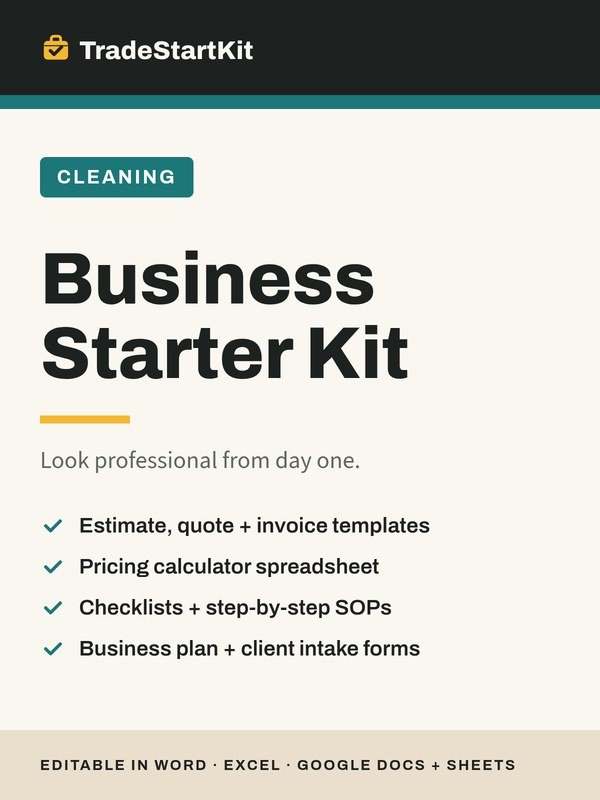
Get every document you need, in one matching set.
Estimates, invoices, pricing calculator, checklists, client forms, service agreement, business plan and 4 step-by-step SOPs. Editable in Word, Excel, Google Docs and Sheets.
See the kit, $37 →